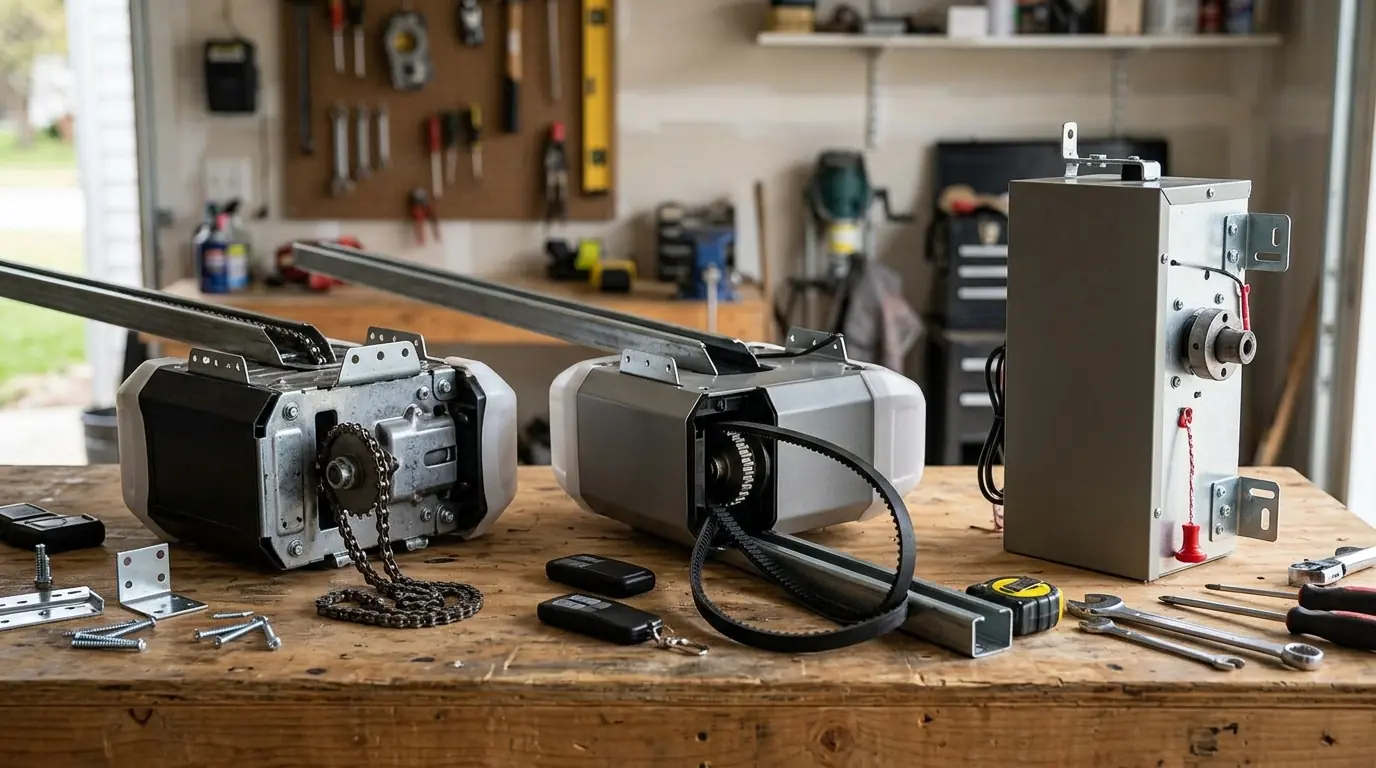
- Belt drives are the quiet choice for attached garages; chain drives are durable and economical.
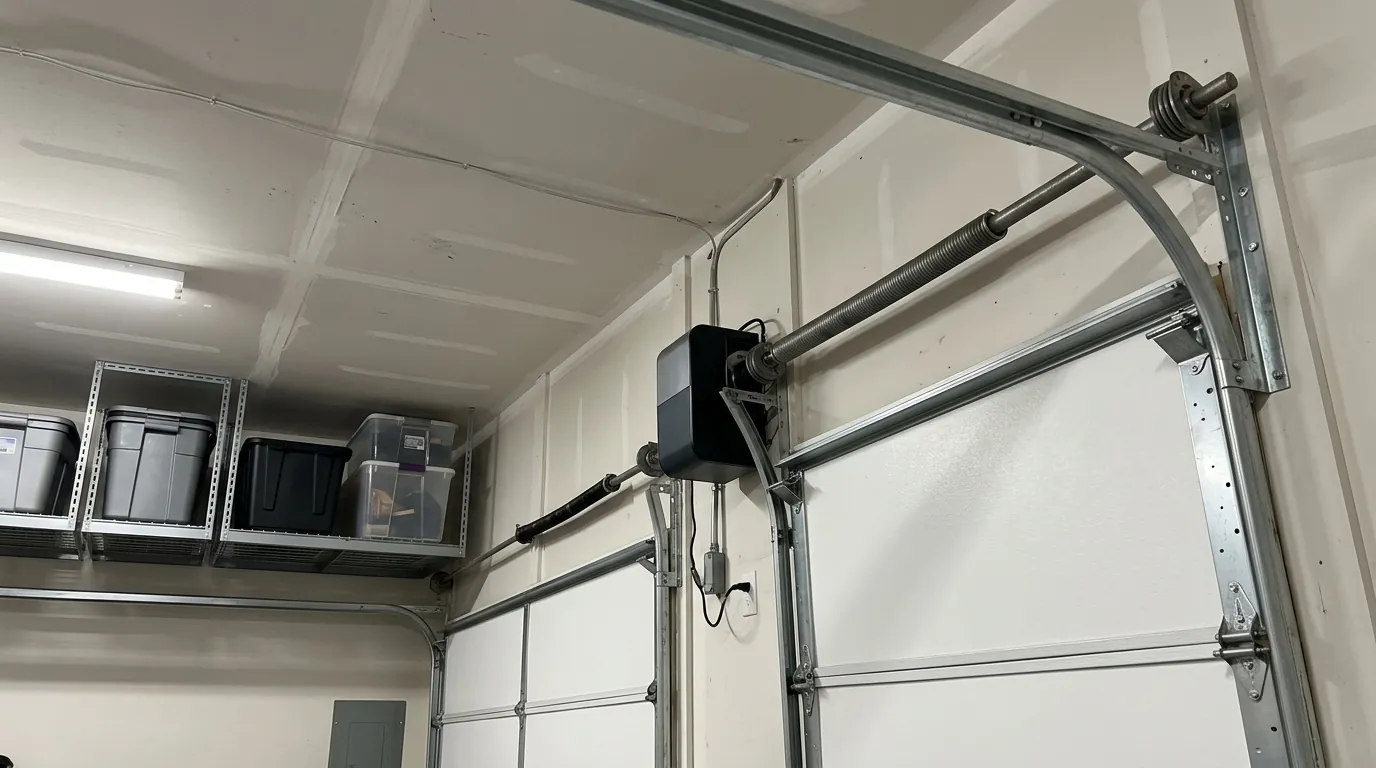
- Wall-mount jackshaft openers clear the ceiling but need a torsion spring system.
- Every residential opener sold or installed in California must have battery backup.
- HomeAdvisor puts installed openers at $220 to $520.
Drive types at a glance
| Type | Noise | Mounting | Best for |
|---|---|---|---|
| Chain drive | Loudest | Ceiling rail | Detached garages, tight budgets |
| Belt drive | Quiet | Ceiling rail | Attached garages, rooms above |
| Wall-mount jackshaft | Very quiet | Beside the door on the torsion shaft | High or crowded ceilings, storage racks |
Screw-drive openers also exist but are less common today; most installs choose between belt, chain and wall-mount.
Power and door weight
Opener strength is matched to the door, not the other way around. A balanced standard door needs surprisingly little lifting power, because the springs carry the weight. Heavy wood, oversized and insulated doors call for a stronger unit. Before any new opener goes in, the door should be balanced; an opener on an unbalanced door wears out early.
Smart features worth having
- Smartphone control and alerts when the door is left open.
- One-time or scheduled access for deliveries and visitors.
- Keypads for entry without a remote.
- Quiet soft-start and soft-stop motors.
Safety and California's backup rule
Federal safety rules have required reversing protection on residential openers for decades, which is what the photo eyes near the floor provide. California adds a second requirement: since July 1, 2019, every residential opener sold or installed in the state must have battery backup, so the door works during an outage. Any opener we install meets both.
What it costs
HomeAdvisor's 2026 figures put installed openers between $220 and $520, with belt drives, wall-mount units and premium smart features at or above the top of that range. When the Assembly analyzed the backup law in 2018, it estimated a new opener with battery backup at $150 to $350 for the unit.
What happens on installation day
A good install starts with the door, not the opener: the tech checks springs and balance, then removes the old unit, mounts the new one to solid framing, sets the photo eyes at the correct height, programs remotes, the keypad and the phone app, and sets force and travel limits. The visit ends with a reverse-on-contact test and a demonstration of the manual release. Most ceiling units take two to three hours; wall-mount units and first-time installs that need new wiring can take longer.
Repair or replace the opener you have?
A sensor, remote or gear repair on a healthy unit is usually worth doing. A logic board or motor on an older opener can approach the price of a new one, which brings battery backup and modern features. See opener repair or opener installation for how we handle each.
Questions readers ask
If a bedroom, office or living room sits near the garage, almost always. In a detached garage, a chain drive is fine.
It needs a torsion spring system and enough side clearance. Doors with extension springs can be converted first.
Generally not. They are matched to the opener's model and safety system.
Sources
Figures on this page come from the sources below, checked on October 1, 2026. Prices are national or statewide ranges; your quote depends on the door in front of us.
- HomeAdvisor: garage door prices and repair costs
- California SB 969 bill text (LegiScan)
- California Assembly analysis of SB 969
About the author
Gilbert Dorsey edits the Door Guides for Master Overhead Doors, turning the questions callers bring to dispatch into plain-language guides. Cost figures are linked to their published sources and revisited when those sources change.