Opener repair starts with the door, not the motor. A tech disconnects the opener and checks that the door is balanced, because most openers that die were worked to death by a tired spring. Then come sensors, gears, logic board and controls, in that order. When a unit is old enough that repair money is better spent on a battery-backup replacement, you hear that before anything is installed.
What the visit covers
- Door disconnected and balance-tested before the opener is blamed
- Photo-eye alignment, wiring and bracket faults corrected
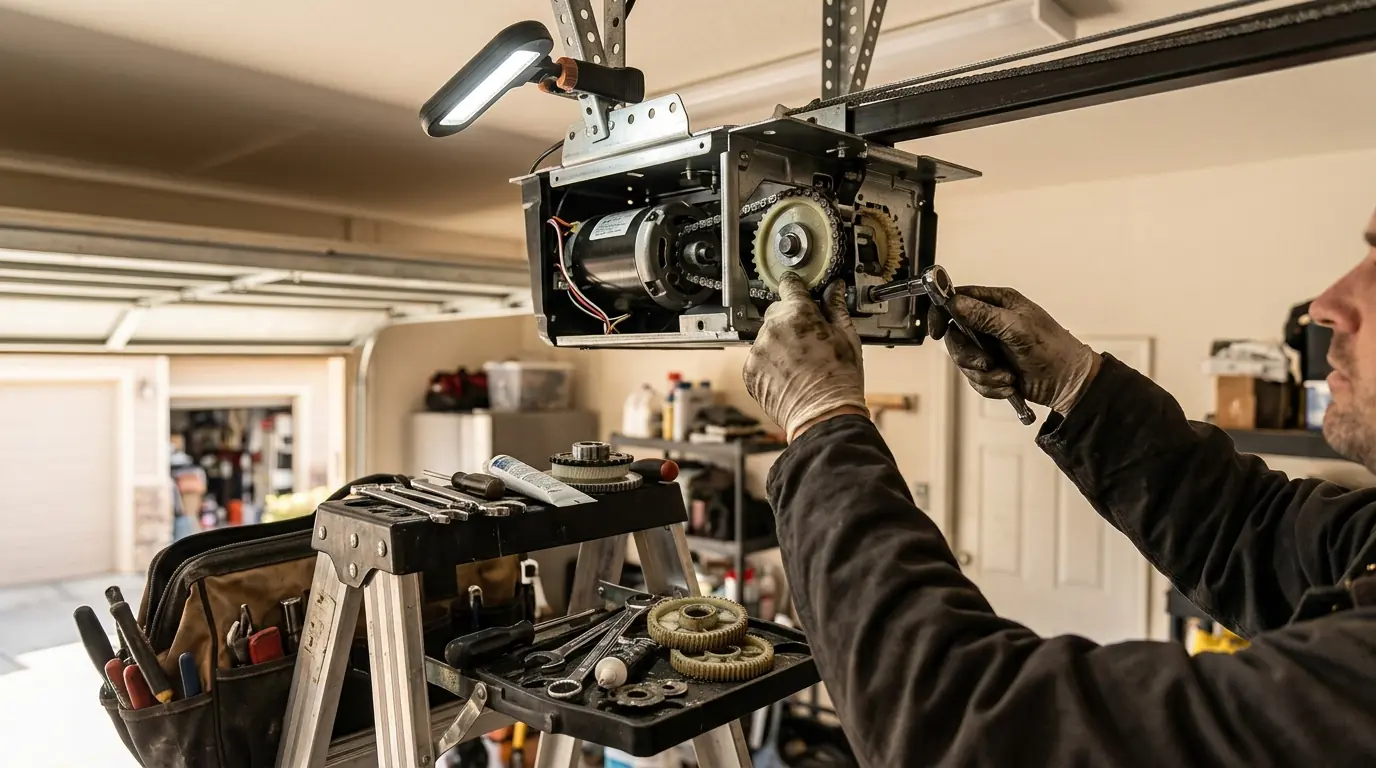
- Stripped drive gears and worn sprockets replaced
- Logic boards diagnosed and swapped after surges or failures
- Remotes, keypads and wall buttons reprogrammed or replaced
- Force and travel limits reset, then a reverse-on-contact test

Safety sensor and photo-eye faults
A door that starts down and bounces back up, or only closes while you hold the wall button, is usually a sensor problem: eyes nudged out of line by a trash bin, low sun washing out the beam, or a wire chewed through at a staple. These are the cheapest opener calls on the board and the most common. Reversing protection has been required on residential openers since 1993, so we fix the sensors and never bypass them.
Stripped gear and sprocket
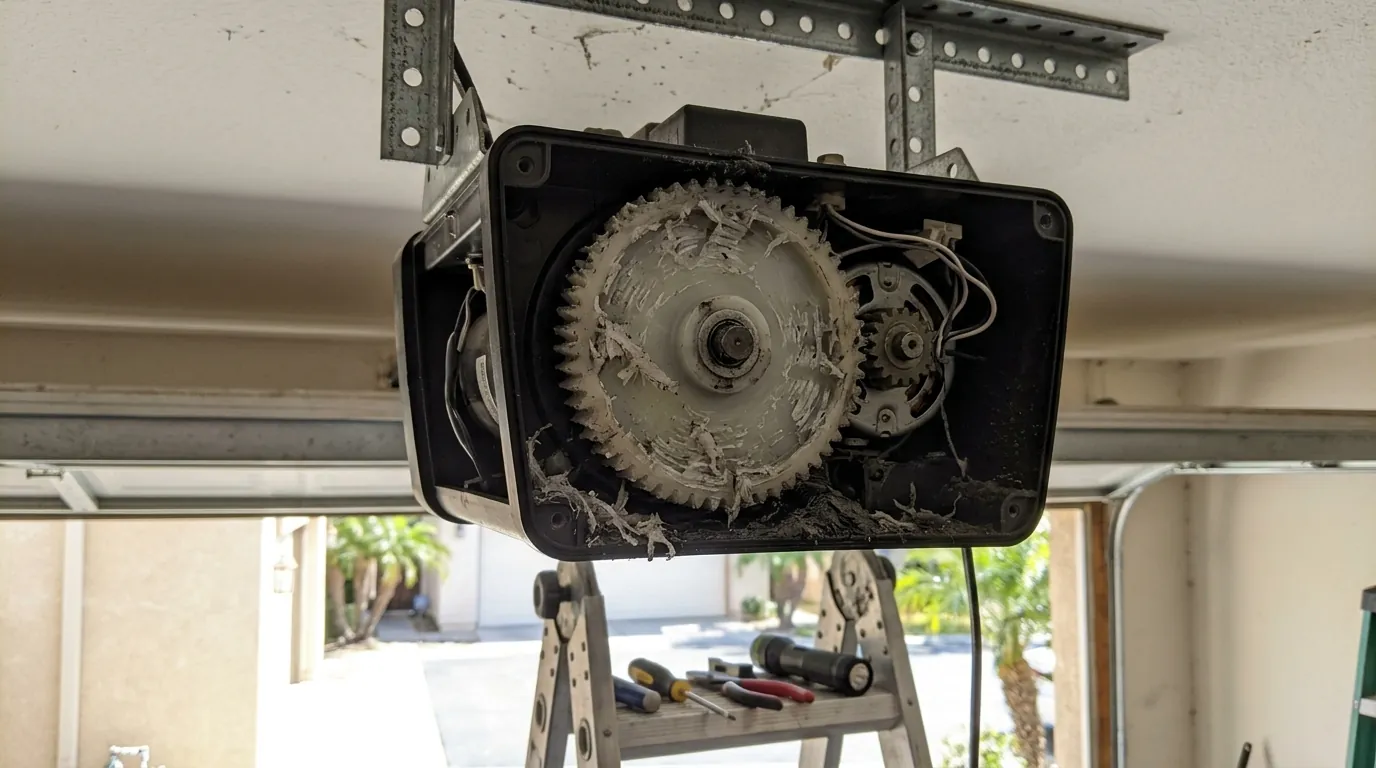
A motor that hums, runs and moves nothing has usually shredded its main drive gear. On many popular chain and belt units that gear is plastic by design, the sacrificial part that fails before the motor does. Replacing gear and sprocket together restores the opener for a fraction of a new unit, provided the door it lifts is balanced; otherwise the new gear goes the same way.
Logic board and surge damage
Dead after a storm, unresponsive to every button, light blinking in a pattern: that is often the logic board. Surges and age kill them, and the diagnostic blink codes on most modern units narrow the fault quickly. Boards for current models are a straightforward swap. For discontinued openers a board can cost enough that replacement wins the arithmetic, and we will say so.
Remote and keypad programming
Remotes that work from the driveway but not the street, keypads that went dead after a battery change, a new car whose built-in buttons will not learn: most of these are programming, battery or rolling-code compatibility issues, solved in minutes. Lost remotes get erased from the opener's memory first, so a stray clicker cannot open your garage.
On the job
Second-generation openers, first-generation habits
About one in five homes across the San Diego metro was built during the 1970s, the largest single decade of construction, and a lot of those garages are now on their second opener at most. Anything sold in California since July 2019 must carry battery backup, so a repair visit here often doubles as a quiet audit: is this unit worth another fix, or is its next failure the right moment to move to an outage-ready replacement? We give you that read with the repair quote.
What opener repair costs
Bob Vila's published range for replacing an opener motor runs $180 to $400, while HomeAdvisor's broader repair data clusters at $150 to $400 with about $250 typical. Sensor realignment and remote programming land well below both; a board for a discontinued unit can climb toward the price of a new opener, which is exactly where we stop and show you both numbers. The levers:
Questions callers ask about this job
Usually the drive gear stripped, or the door became too heavy because a spring broke. Look at the springs above the door first; if a coil shows a gap, leave the door down and tell dispatch. If the springs look whole, a gear and sprocket kit is the likely fix.
Most often the photo eyes see something, sit slightly out of line, or are blinded by low sun. The other suspect is close-force set too sensitive for a door that has stiffened with age. Both are quick adjustments.
Sometimes. A sensor or remote fix, yes. A board or motor can approach the price of a new battery-backup unit with modern safety and phone control, and that comparison is the one we put in front of you.
In most cases, yes. Compatibility depends on the opener's rolling-code generation and the car's system; where they will not talk, a small bridge receiver usually solves it.
Of course. LiftMaster, Chamberlain, Genie, Craftsman, Marantec and the other common residential brands, regardless of who hung them.