- More than 27 percent of San Diego city housing was built from 1940 to 1969, the tilt-up era.
- A conversion is a new sectional door plus jamb, header and spring-hardware work.
- Pivot springs on tilt-up doors are dangerous to remove; this is a professional job.
- Plan for a battery-backup opener, which California requires on new installs.
How tilt-up doors work, and fail
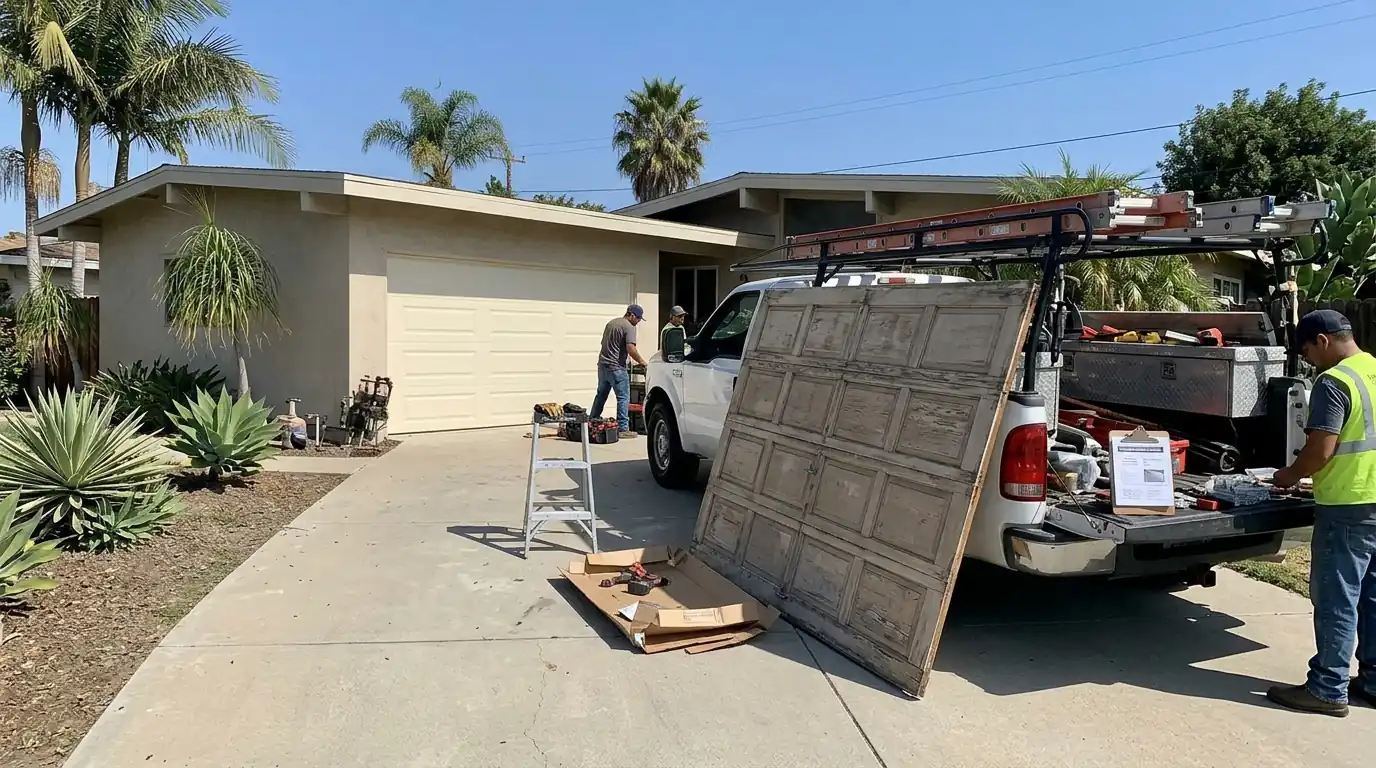
A one-piece door is a single slab that pivots out and up on brackets, counterbalanced by large springs at each side. It swings out over the driveway as it opens, so the car has to be clear. With age, the pivot springs weaken, brackets wear and the slab sags or drags, and when a spring or bracket fails, the door can become difficult or unsafe to operate.
Why owners convert
- No more swing-out clearance; you can park close to the door.
- Much better weather sealing than a slab hanging in the opening.
- Modern, balanced torsion springs instead of aging pivot springs.
- Compatible with a quiet, battery-backup opener.
- A chance to choose a style that suits the house, including vintage looks.
Headroom, side room and framing
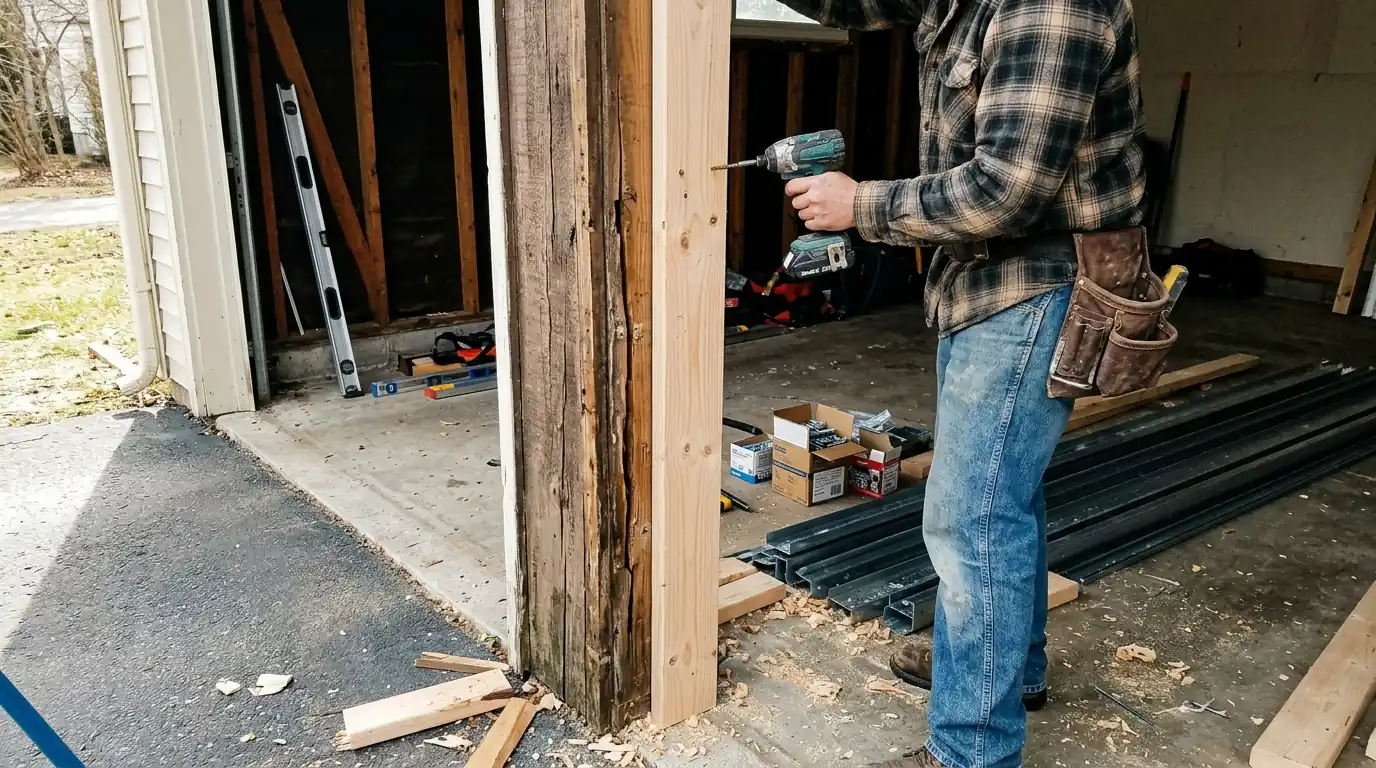
Sectional doors need some headroom above the opening for the track and springs, and a little side room for the vertical tracks. Low-headroom track kits handle many tight garages. Tilt-up openings were often framed around the old hardware, and decades of pivot-spring stress can leave jambs split or out of plumb, so the framing gets checked and trued before the new door goes in.
What the conversion involves
- Measure the opening, headroom and side room.
- Release the pivot springs under control and remove the old door and hardware.
- Repair, true or reinforce the jambs and header as needed.
- Install the sectional door, track, torsion springs and cables.
- Install or pair a battery-backup opener.
- Balance the door and test safety reversal.
What it costs
A conversion is priced like a new door installation plus prep work. HomeAdvisor's 2026 figures place replacement doors between $400 and $10,000, with about $1,500 typical, and Angi puts installation labor at $200 to $500 on standard jobs. Framing repairs and a new opener add to the total, which is why we quote the conversion as one package.
Questions to ask before you book
- Will the quote include removing the pivot springs and old hardware?
- Who checks and repairs the jambs and header if they are split or out of plumb?
- Is a low-headroom track kit needed for my garage?
- Does the price include a battery-backup opener and its installation?
- How will the old door and hardware be hauled away?
Keeping the vintage look
You do not have to give up the character of a mid-century home. Carriage-style and plank-pattern sectional doors can echo the original look while opening overhead on a modern opener. See our tilt-up conversion service for how we run the job.
Questions readers ask
Sometimes, if a spring or bracket is available. But parts for old tilt-up hardware are increasingly scarce, and repairs rarely fix the swing-out and sealing problems.
Most do. We measure headroom and side room first, and low-headroom kits handle many tight garages.
Usually a day, depending on framing repairs and the door chosen.
Sources
Figures on this page come from the sources below, checked on October 1, 2026. Prices are national or statewide ranges; your quote depends on the door in front of us.
- NeighborhoodScout: San Diego housing by year built
- HomeAdvisor: garage door prices and repair costs
- Angi: garage door installation cost
- California SB 969 bill text (LegiScan)
About the author
Gilbert Dorsey edits the Door Guides for Master Overhead Doors, turning the questions callers bring to dispatch into plain-language guides. Cost figures are linked to their published sources and revisited when those sources change.